Wan Fambul Framework (WFF): Qualitative Assessment Report
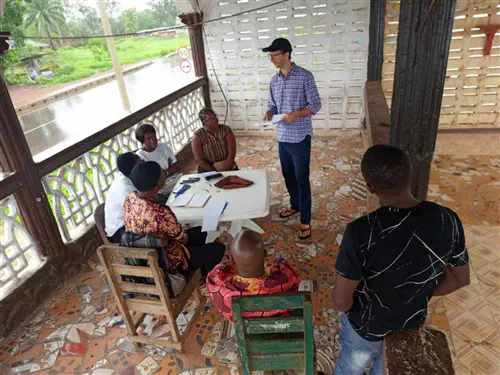 Training the research team in Moyamba District
Abstract
The Government of Sierra Leone’s Wan Fambul Framework (WFF) is a national program designed to enhance citizen participation in development planning. This report assesses the village-level development planning program run by the Fambul Tok NGO (the FT intervention), with an eye towards informing the scale-up of a similar initiative within the national WFF. It considers the impact of the intervention on two primary outcomes: citizen participation in local development planning, with a particular focus on female participation, and social cohesion. The assessment is based on 207 semi-structured interviews conducted across three districts where the intervention has been implemented: Moyamba, Koinadugu, and Kono.
I find that community participation in development decision-making occurs at the village, chiefdom, and district council levels, with barriers at each stage: gender norms restrict women’s involvement, chiefdom-level meetings are costly to reach, and participation at the district level is limited by difficulties accessing elected Ward Councilors. Within the intervention, bonfires played a key role in fostering dialogue and reconciliation, enabling many communities to resolve personal conflicts including those linked to past war atrocities. Village Development Committees successfully mobilized local resources to fund development projects, and Peace Mothers Groups operate savings groups that support members with educational costs, income-generating activities, and emergency financial aid. Youth groups, by contrast, appear considerably less active. The intervention increased female participation in community decision-making through two complementary mechanisms — economic empowerment through savings groups, and sensitization workshops that educated both men and women on women’s right to participate — and improved social cohesion, with communities increasingly resolving disputes internally.
The report closes with seven recommendations for the design of a future WFF village development program, including retaining the bonfire as a core component, earmarking grant funding for women, consolidating village groups, redirecting community contributions toward project maintenance, and building gender sensitization into standard facilitation.
This study was prepared by Baobab Sierra Leone. I was the technical lead for the study and authored the report, under the direction of World Bank TTLs Stephen Winkler and Audrey Sacks. It was published by the World Bank as Annex 1 to “Strengthening Citizen Participation in Sierra Leone: A Policy and Institutional Roadmap.”
Kevin Grieco
Research Fellow
Political scientist studying state-building and governance in low-capacity contexts.