Business First: The Fiscal Contract in Weak States
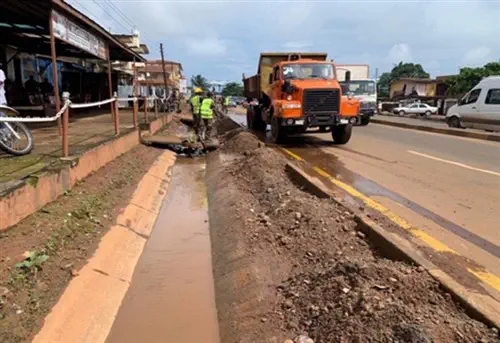 Drainage works in Freetown, shown on the service delivery tax bills sent to property owners
Abstract
Fiscal contract theories hold that citizens comply with taxes in exchange for public services. Governments in low-capacity states that try to build this contract face a dual problem. First, a history of weak service delivery and inefficient administration leaves citizens reluctant to trust that the government will deliver once taxes are paid. Second, even citizens who expect to gain from exchange will not pay unless they believe the government can detect and punish non-compliance. Enforcement capacity is thus a necessary condition for solving the collective action problem at the heart of the fiscal contract. We argue that in many developing contexts the fiscal contract is most likely to emerge first among business owners, who have a deeper history of engagement with the state and who have long faced fiscal extraction.
We test this argument in Freetown, Sierra Leone, where the municipal government made a vocal case for fiscal exchange during a large-scale property tax reform. With the Freetown City Council (FCC), we ran a randomized controlled trial in which 77,912 property owners received different versions of their annual property tax bill. We find evidence that business owners are the most open to fiscal exchange: administrative records show that bills highlighting (i) improved service delivery and (ii) fairer government processes increased compliance among business owners but had no effect on other property owners.
Two pieces of evidence support our argument. First, only business owners find enforcement threats credible: a bill priming enforcement increases compliance among business owners alone. Second, administrative data show that business owners use the state far more, and so gain more when it performs. The fiscal contract, we conclude, rests on quasi-voluntary compliance, in which enforcement remains a necessary condition for exchange.

Kevin Grieco
Research Fellow
Political scientist studying state-building and governance in low-capacity contexts.